
API identity verification in Africa is reshaping how millions of people access financial services, government systems, and digital platforms. What was once a slow, paper-driven process has become a millisecond transaction, and the continent is leading the world in deploying it at scale.
There was a time when verifying someone’s identity meant paperwork, physical presence, and days of waiting. You filled forms. You submitted copies. You waited. But Africa’s digital economy moves too fast for that now. A fintech startup can onboard thousands of users in a single day. A digital bank can scale across multiple states within months. Government platforms must authenticate millions of citizens in real time.
Manual systems cannot keep up. This is where the quiet revolution began, not with headlines, but with APIs. And the revolution in API identity verification across Africa is still accelerating.
How API Identity Verification in Africa Actually Works
Behind every seamless onboarding experience is an invisible conversation happening between systems. An API connecting identity databases to financial platforms. A verification engine confirming compliance instantly. A background check runs in milliseconds. Compliance is no longer a department; it is embedded in code.
This shift is profound. Because in Africa, trust has always been the biggest currency. Financial systems depend on it. Digital platforms require it. Regulatory bodies enforce it. API identity verification Africa-wide transforms trust into programmable infrastructure. Instead of asking “can we verify this person?” the system already knows instantly, compliantly, and at the scale that modern digital commerce demands.
Financial Inclusion: When API Identity Verification Unlocks Access
For decades, millions across Africa were excluded from formal financial systems because onboarding processes were slow, rigid, or inaccessible. The documents required did not match the realities of informal economies. The branches were too far. The processes were too long.
With embedded API identity verification, onboarding can now happen through mobile devices — securely, compliantly, and at scale. According to the GSMA State of the Industry Report on Mobile Money, over 763 million registered mobile money accounts exist in sub-Saharan Africa. API-driven verification is the backbone enabling that growth. Inclusion is no longer limited by paperwork. It is enabled by infrastructure.
The Business Model Shift: Verification as Recurring Infrastructure
Verification is no longer a one-time service. It has become recurring, scalable, subscription-based infrastructure. Organizations integrate compliance into their platforms as a continuous service, not a one-off checkbox. The Central Bank of Nigeria’s KYC guidelines now explicitly support tiered digital verification a regulatory green light for embedding API identity verification across the financial sector.
This evolution moves digital identity from static to dynamic. Verification adapts as users’ data changes. Risk scores update in real time. Fraud patterns are flagged before transactions complete. This is the power of treating API identity verification in Africa not as a compliance burden, but as intelligent infrastructure.
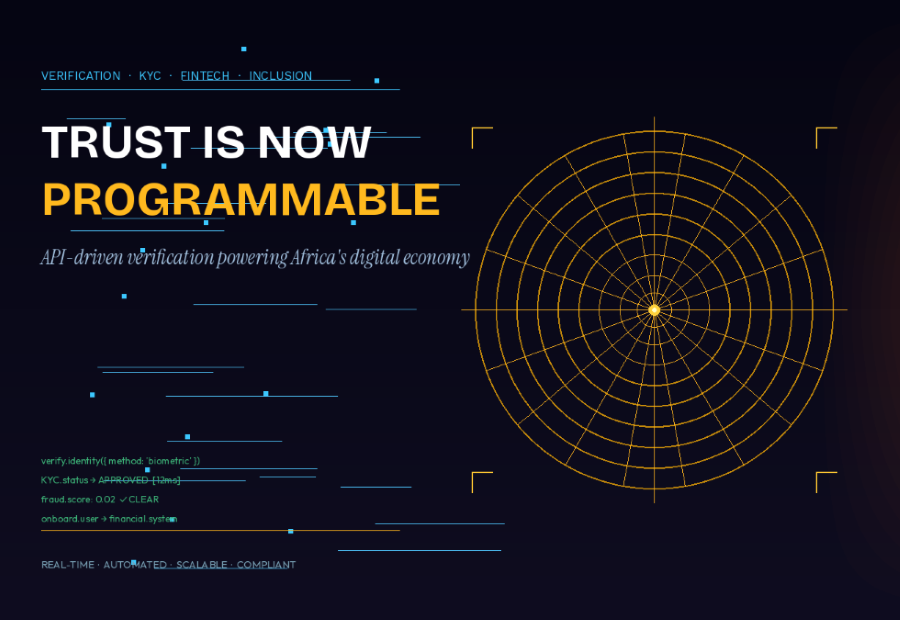
Trust is now programmable. And in Africa, that changes everything.